Data-Driven Selling
Sales Intelligence CRM vs. Traditional CRM: Key Differences Explained
The Regie Team
|
Jul 29, 2026

Introduction
Sales teams face significant challenges in effectively utilizing data for outreach due to fragmented tech stacks and outdated workflows.
Sales Intelligence CRMs streamline customer relationship management by providing actionable insights that improve decision-making and boost sales performance.
It's essential to understand how Sales Intelligence CRMs address the limitations of traditional CRMs and the advantages they bring to sales teams.
Sales Intelligence CRMs not only enhance efficiency but also empower sales teams with data-driven strategies that lead to measurable success.
Define Sales Intelligence and Its Role in CRM
Sales teams struggle with fragmented data that hinders effective outreach. Sales analytics collects and analyzes data to reveal insights about potential customers and market trends. It includes data points like firmographics, behavioral signals, and engagement metrics that help teams identify high-potential leads and tailor outreach strategies.
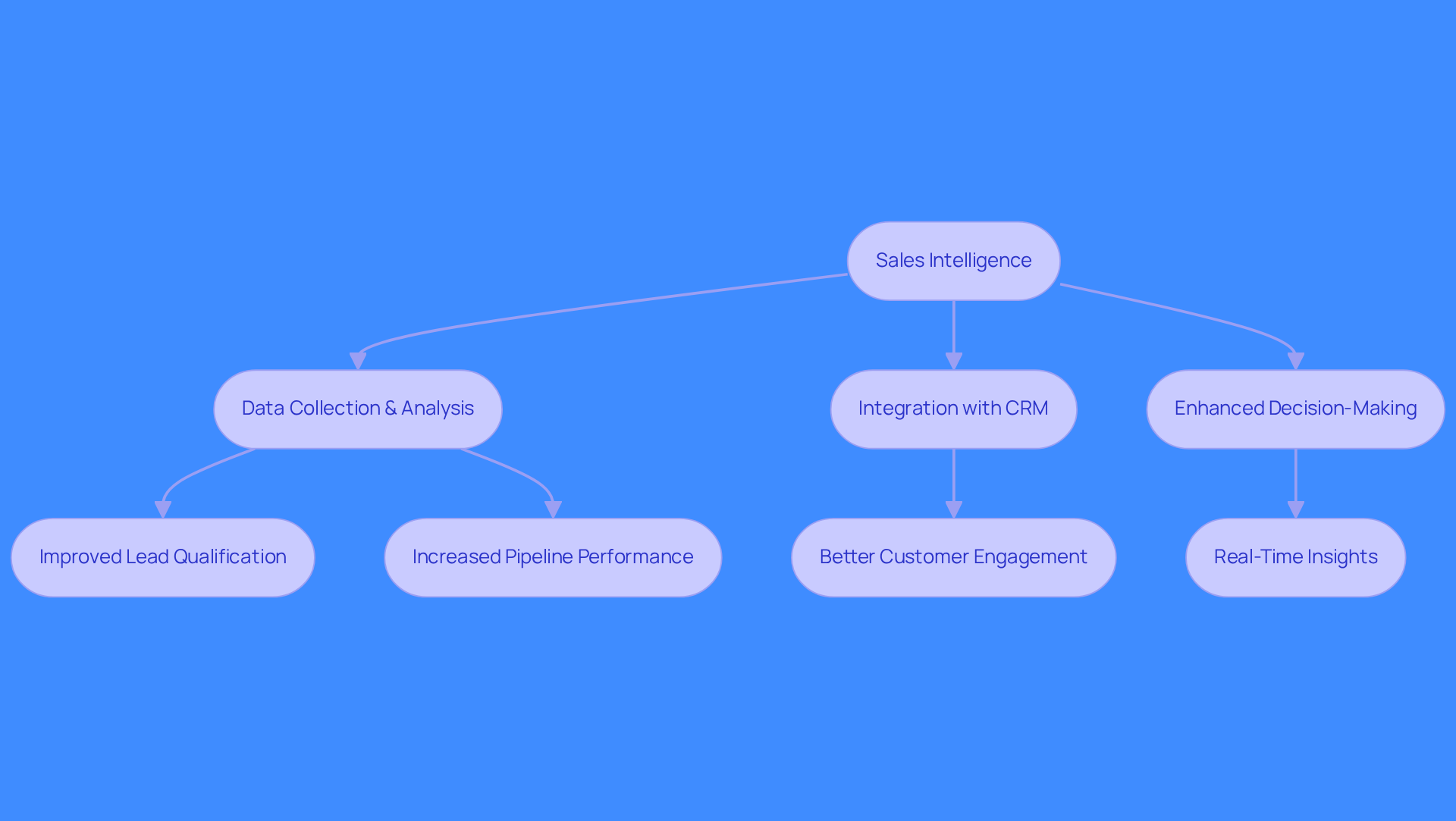
In sales intelligence CRM, the integration of sales knowledge enhances customer relationship management by adding practical insights to stored information. Market insights transform sales intelligence CRM systems from simple data storage into strategic tools that drive decision-making and business initiatives. Firms using sales intelligence CRM tools see a 20-40% increase in pipeline performance, proving the value of these insights in their systems.
Case studies show that organizations using sales insights find new opportunities and improve lead qualification, leading to more efficient processes and better customer engagement. By 2026, sales intelligence CRM systems will expand, emphasizing real-time information and predictive analytics to enhance sales initiatives and results.
Regie.ai enhances insights by automating outreach and improving the buyer experience with dynamic workflows. With AI-driven automation, small teams can scale outbound efforts, reaching 3 to 5 times more accounts without adding headcount. Regie.ai crafts personalized messaging across email, LinkedIn, and calls, making outreach efficient and relevant to potential customers.
Regie.ai's parallel dialing feature increases talk time and pipeline by letting reps dial up to nine lines at once, boosting productivity. Integrating with platforms like Salesforce and LinkedIn, Regie.ai ensures smooth data flow and campaign alignment, helping teams navigate tough market conditions.
Compare Features of Sales Intelligence CRM and Traditional CRM
Traditional CRMs struggle with manual data entry, while sales analytics systems streamline the process through automation.
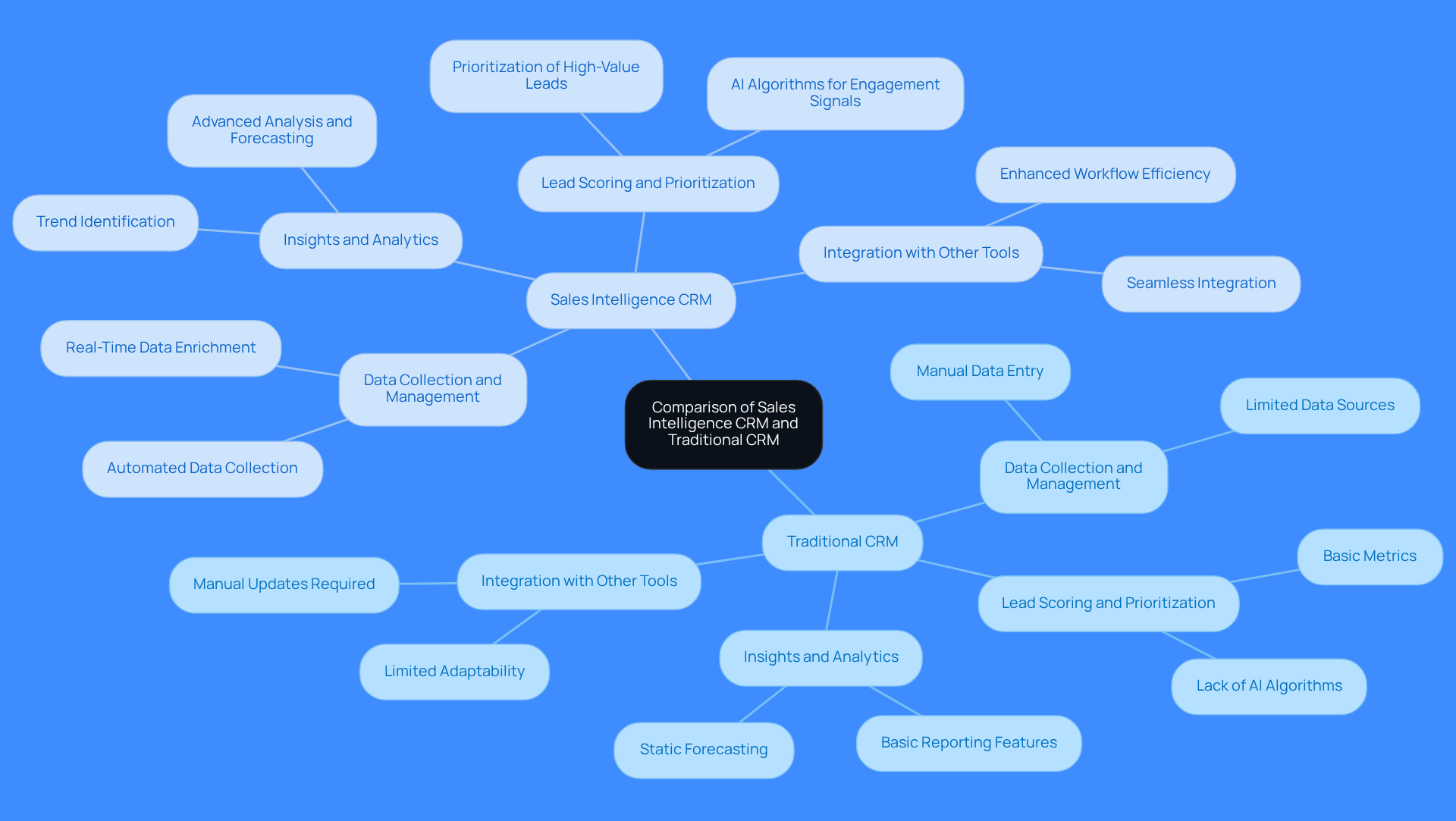
Data Collection and Management: Traditional CRMs primarily focus on storing customer information entered manually by users. Sales intelligence CRM systems automate data collection from social media, email, and web activity, keeping information current and accurate. This automation significantly reduces the time sales teams spend on data entry, allowing them to focus on selling.
Lead Scoring and Prioritization: Conventional customer relationship management systems often lack advanced lead scoring capabilities, relying on basic metrics to evaluate prospects. Sales analytics systems employ AI algorithms to assess engagement signals and prioritize leads according to their probability of conversion. This allows sales groups to concentrate on high-value opportunities, enhancing overall efficiency and effectiveness in the selling process.
Insights and Analytics: While conventional CRMs provide basic reporting features, sales intelligence CRMs offer advanced analysis that can forecast customer behavior, identify trends, and recommend next steps for engagement. This approach helps teams tailor their strategies, leading to better conversion rates. For example, organizations utilizing revenue analysis tools have reported a 40% rise in conversion rates due to real-time data enhancement.
Integration with Other Tools: Sales intelligence CRM systems are designed to integrate seamlessly with various marketing and sales tools, thereby enhancing workflow efficiency. Conventional customer relationship management systems may need manual updates and lack the adaptability to integrate with contemporary applications, restricting their efficiency in a dynamic business environment. Over 45% of organizations identify data silos as a major barrier to CRM effectiveness, highlighting the need for integrated solutions.
Adopting sales analytics systems can lead to faster deal cycles and improved quota attainment, positioning organizations for success in a competitive landscape.
Evaluate Performance Outcomes: Sales Intelligence vs. Traditional CRM
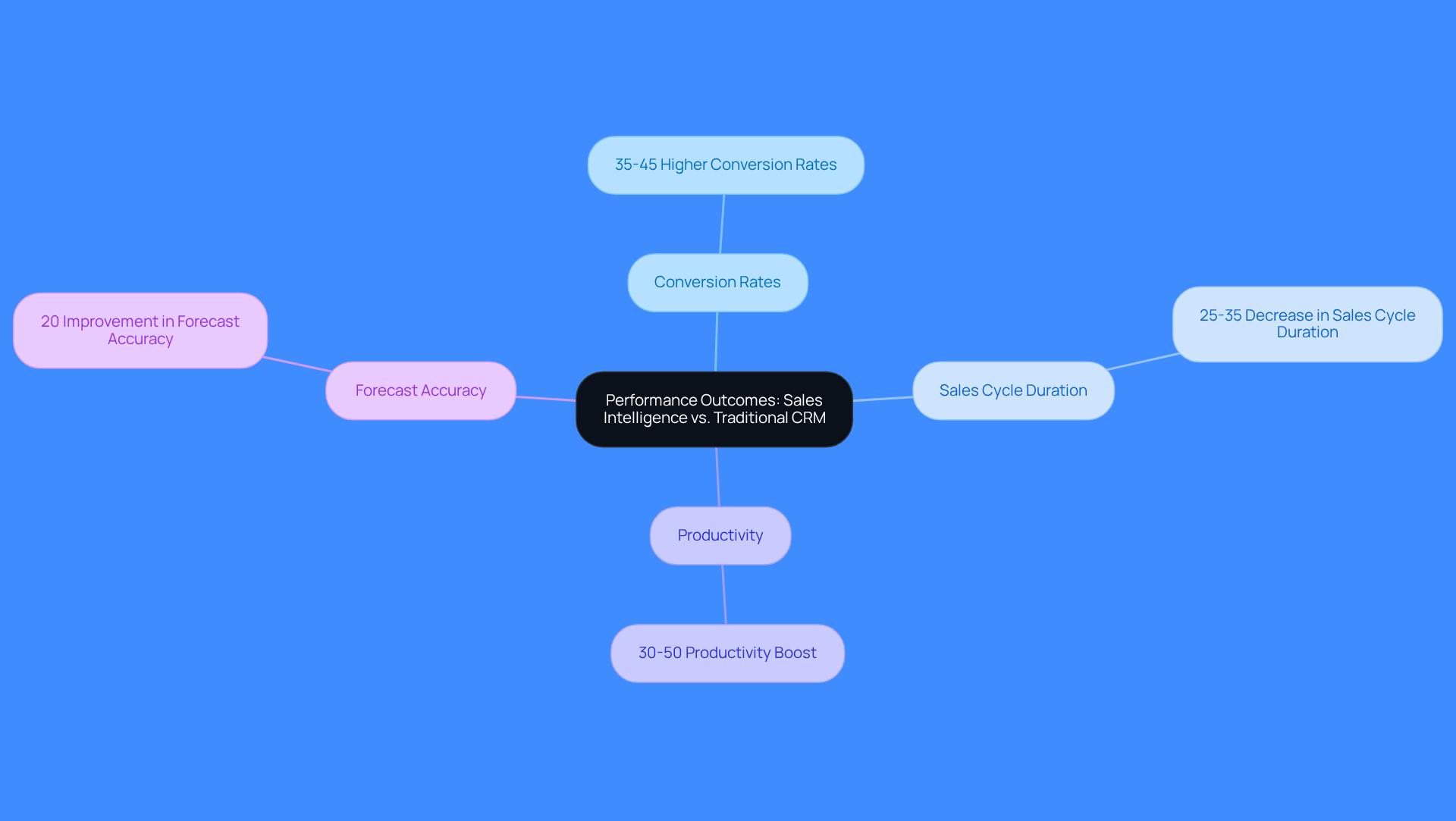
Many organizations struggle with low conversion rates due to their outdated sales intelligence CRM systems. Organizations that utilize sales intelligence CRM systems experience conversion rates 35-45% higher than those using conventional systems. This shift in strategy leads to higher conversion rates and more effective outreach. Sales intelligence CRM systems significantly cut down sales cycle durations. Companies that connect with potential clients using timely information through sales intelligence CRM see sales cycle durations decrease by 25-35% after adopting these solutions. Automating repetitive tasks lets sales reps focus on selling, not admin work. This shift boosts productivity by 30-50% among teams utilizing sales intelligence CRM. Companies have noted enhancements in forecast accuracy by up to 20% compared to traditional methods. The measurable impact of these systems is clear: improved conversion rates and enhanced productivity driven by sales intelligence CRM are no longer optional for competitive organizations.
Assess Suitability for Different Sales Strategies and Business Needs
Organizations face a critical choice between traditional CRM and sales intelligence CRM, which impacts their sales effectiveness and revenue potential.
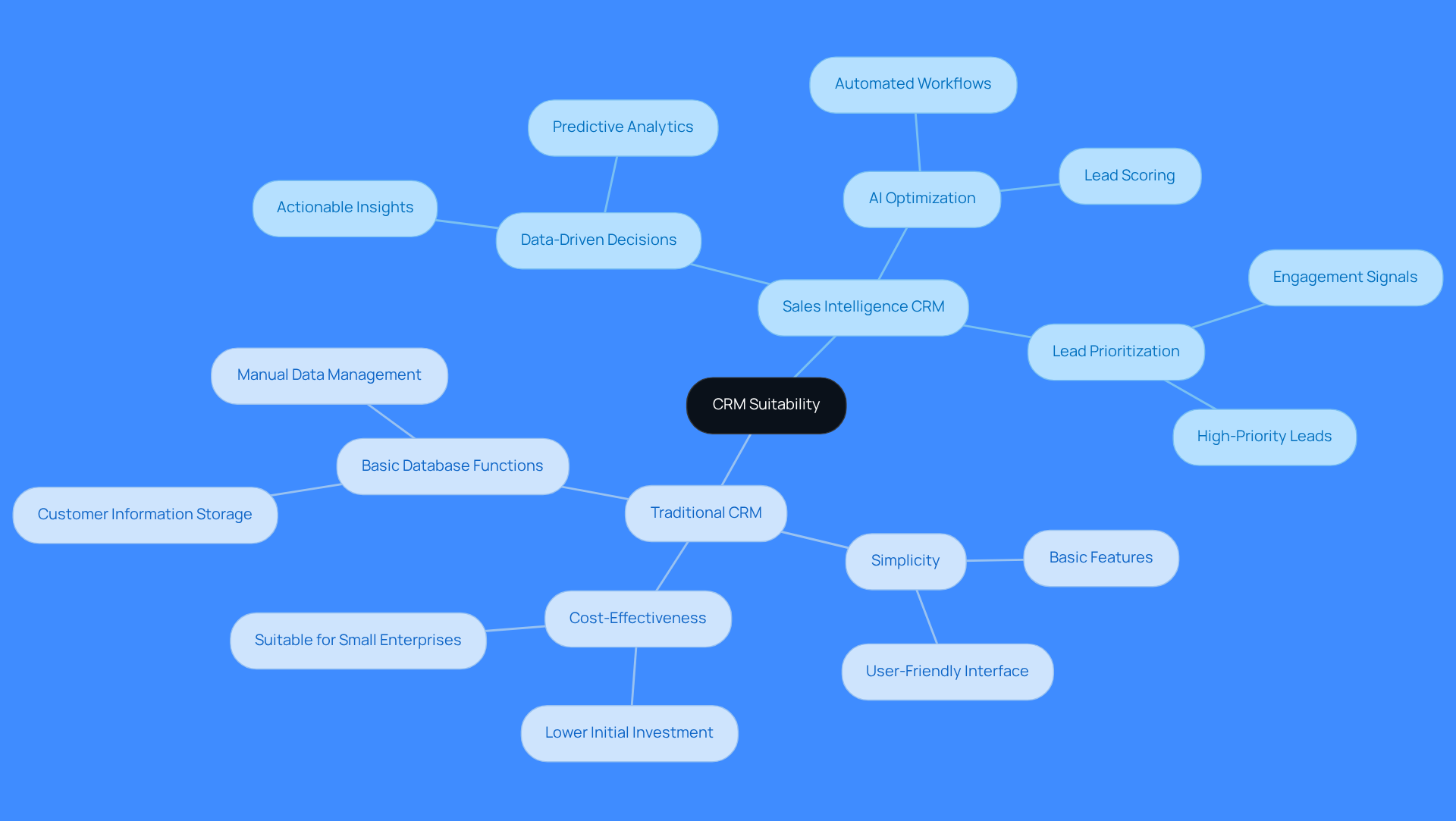
Sales intelligence CRMs enable organizations to make data-driven decisions by providing actionable insights. Many organizations struggle with fragmented data and inefficient sales processes, making the use of a sales intelligence CRM essential for success. Regie.ai's AI agents optimize outreach by adjusting to engagement signals, allowing teams to focus on high-priority leads with personalized communication. These AI agents log interactions in Salesforce and prioritize leads using over 100 signals from sources like Google and LinkedIn.
Conversely, traditional customer relationship management systems suit smaller enterprises or those with straightforward sales processes. Organizations that do not require advanced analytics or automation may find traditional CRMs adequate. These systems often serve as robust databases for storing customer information but may lack the actionable insights and advanced automation features that modern business environments demand. For businesses just starting their CRM journey, the simplicity and lower cost of traditional solutions can be appealing.
Choosing the right CRM can significantly impact revenue growth and operational efficiency. The right CRM choice can be the difference between stagnation and significant revenue growth.
Conclusion
Traditional CRMs often fall short in providing the insights needed for effective sales strategies. Sales intelligence CRMs automate data collection and prioritize leads, enabling teams to focus on high-value opportunities and improve conversion rates. These systems provide real-time data that helps teams make informed decisions and streamline their outreach efforts.
Choosing a sales intelligence CRM over a traditional CRM directly influences an organization's sales strategy and success. Organizations that prioritize sales intelligence CRM systems will see measurable improvements in efficiency and revenue outcomes.
Frequently Asked Questions
What is sales intelligence and how does it relate to CRM?
Sales intelligence involves collecting and analyzing data to provide insights about potential customers and market trends. In CRM, it enhances customer relationship management by integrating practical insights with stored information, transforming simple data storage into strategic tools for decision-making.
What types of data are included in sales analytics?
Sales analytics includes data points such as firmographics, behavioral signals, and engagement metrics, which help sales teams identify high-potential leads and tailor their outreach strategies.
How does sales intelligence CRM improve pipeline performance?
Firms using sales intelligence CRM tools experience a 20-40% increase in pipeline performance by leveraging insights that lead to better decision-making and more effective outreach.
What benefits do organizations gain from using sales insights?
Organizations that utilize sales insights find new opportunities, improve lead qualification, and enhance customer engagement, leading to more efficient sales processes.
What future trends are expected in sales intelligence CRM systems?
By 2026, sales intelligence CRM systems are expected to expand with a focus on real-time information and predictive analytics to further enhance sales initiatives and results.
How does Regie.ai enhance sales intelligence?
Regie.ai enhances insights by automating outreach and improving the buyer experience through dynamic workflows, allowing small teams to scale outbound efforts significantly without increasing headcount.
What features does Regie.ai offer to improve outreach efficiency?
Regie.ai crafts personalized messaging across email, LinkedIn, and calls, making outreach more efficient and relevant. It also includes a parallel dialing feature that allows representatives to dial up to nine lines simultaneously, boosting productivity.
How does Regie.ai integrate with other platforms?
Regie.ai integrates with platforms like Salesforce and LinkedIn to ensure smooth data flow and campaign alignment, helping sales teams navigate challenging market conditions.
List of Sources
- Define Sales Intelligence and Its Role in CRM
- 7 CRM trends for 2026: AI brings decisive action to customer workflows (https://cio.com/article/1255983/customer-relationship-management-crm-trends.html)
- Sales Intelligence: Definition, Tools & How They Help Sales Teams (https://contify.com/resources/blog/sales-intelligence)
- What Is Sales Intelligence and Why It Matters in 2026 (https://cognism.com/blog/sales-intelligence?hs_amp=true)
- What is Sales Intelligence? (And How to Use It to Close More Deals) (https://salesforce.com/sales/sales-intelligence)
- Sales Intelligence Explained: Benefits, Data & Tools (https://nocrm.io/blog/sales-intelligence-what-is-it-and-what-tools-should-you-use)
- Compare Features of Sales Intelligence CRM and Traditional CRM
- Difference Between Traditional CRM and AI-Driven Platforms (https://spotlight.ai/post/difference-between-traditional-crm-and-ai-driven-platforms)
- Sales Intelligence vs CRM vs Revenue Intelligence - What's the Real Difference? (https://marketsandmarkets.com/AI-sales/sales-intelligence-vs-crm-vs-revenue-intelligence)
- CRM vs Sales Intelligence Platforms: 2026 Key Differences (https://buzz.ai/blog/crm-vs-sales-intelligence-platforms-2026-key-differences)
- 53 must-read CRM statistics and trends for 2026 (https://sopro.io/resources/blog/crm-statistics)
- 30+ CRM Statistics to Increase Sales (https://activecampaign.com/blog/30-crm-statistics-to-increase-your-sales)
- Evaluate Performance Outcomes: Sales Intelligence vs. Traditional CRM
- Winning the Customer Game: How Sales Intelligence Boosts Conversions - Custify Blog (https://custify.com/blog/sales-intelligence-boosts-conversions)
- AI platforms for sales performance optimization: A guide for revenue teams (https://monday.com/blog/crm-and-sales/ai-tools-for-sales-performance-optimization)
- The Ultimate Guide to Sales Intelligence | OrbitShift (https://orbitshift.ai/resources/blogs/ultimate-guide-to-sales-intelligence)
- Sales Intelligence 101: What It Is, Why It Matters & 2026 Trends | SalesPlay (https://marketsandmarkets.com/AI-sales/sales-intelligence-how-Its-evolving)
- Assess Suitability for Different Sales Strategies and Business Needs
- Traditional CRM vs. AI-Powered CRM: Comparative Analysis | Merlin CRM (https://merlincrm.io/blog/traditional-crm-vs-ai-powered-crm-a-comparative-analysis)
- 25 CRM Statistics Every Sales Leader Should Know (https://teamgate.com/blog/crm-statistics-sales-leaders)
- AI CRM vs. Traditional CRM: How to Choose the Right Fit (https://salesforce.com/au/crm/ai-crm-vs-traditional-crm)
- Why Traditional CRM is Slowing Down Sales Teams | Rebel Commerce Solutions posted on the topic | LinkedIn (https://linkedin.com/posts/rebel-commerce-solutions_crm-ai-b2bsales-activity-7486108955706806274-LnD4)
- The Death of the Traditional CRM (And What’s Replacing It) (https://medium.com/@williamflaiz/the-death-of-the-traditional-crm-and-whats-replacing-it-e2654ab49bd9)